The Diplomatic Track Is Dead. Price That First.
Start with the fact that reorders everything else. The first direct negotiations between American and Iranian officials since 1979 lasted twenty-one hours before they collapsed. Islamabad brokered them, staked its credibility on them, and failed. That failure is not a pause. It is the removal of the mechanism that both capitals could hide behind. For four decades, the absence of direct talks was itself a form of stability — a way for each side to posture without testing the other’s resolve. That buffer is now gone, and there is no obvious replacement waiting in the wings.
Understand what the Pakistani channel actually was, stripped of the diplomacy. It was the last low-cost off-ramp. When a mediator with standing in both Tehran and Washington cannot hold a conversation together for a single day, the message to markets is not “talks are difficult.” The message is that the parties have concluded there is nothing to say. Decision-makers who are still modeling a negotiated de-escalation as the base case are working from a scenario that expired at hour twenty-one. Move it to the tail.
A Blockade to Seal, Not to Open
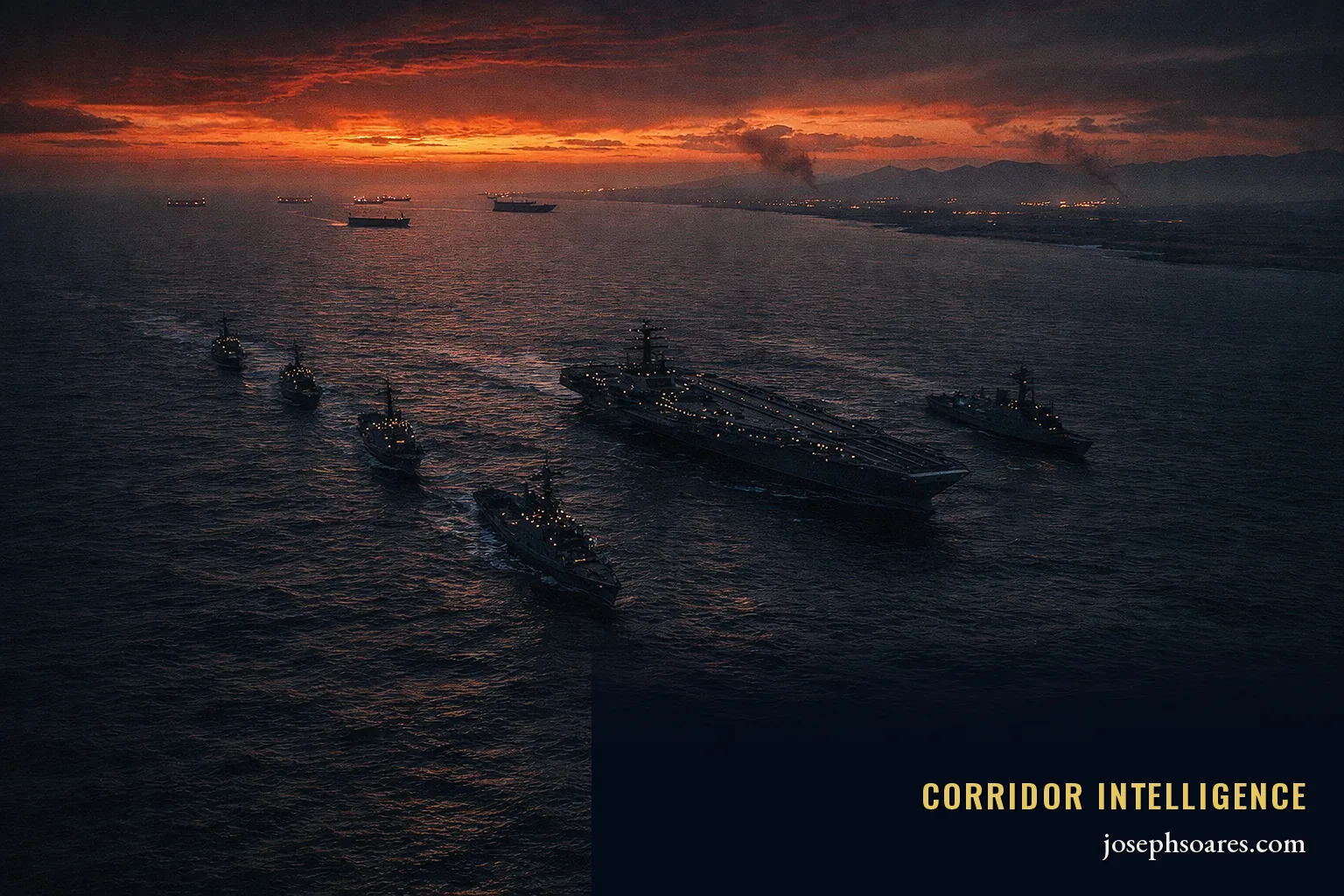
Now the substance. President Trump has ordered a naval blockade of the Strait of Hormuz. Read the intent precisely, because the intent is the whole story: the objective is not to reopen the strait or to guarantee passage. It is to seal it. That inverts the usual American posture toward Hormuz, which for a generation has been to keep oil moving. Washington is now choosing to stop the flow itself and to own the consequences — a deliberate act of economic strangulation aimed at forcing a weaker adversary to fold. Oil futures jumped 7% on the announcement, and that move should be read as a down payment, not a settlement. Markets have priced the shock of the decision. They have not yet priced its duration.
The fitting historical comparison is not the tanker wars of the 1980s. It is Cuba, October 1962. The structure is identical in the ways that matter: a naval blockade of a critical chokepoint, a weakened but nuclear-capable adversary, and a President betting that the other side folds before the world breaks. In 1962 the bet paid off, and it has been mythologized ever since as a triumph of nerve. What the mythology obscures is how close the resolution ran to catastrophe, and how much of the favorable outcome depended on private channels that had not yet been publicly burned. The 2026 version begins with the mediating channel already in ruins.
Why Iran’s Weakness Is Not Reassurance
Here is the analytical trap, and it is the one most portfolios will fall into. Iran is structurally weaker than any adversary that has ever faced an American blockade. Its economy is sanctioned to the bone, its currency is hollowed out, its proxies are degraded, and its conventional navy cannot contest the United States at sea. Every one of those facts is true, and every one of them argues that Tehran should capitulate. The temptation is to conclude that a weak adversary makes for a short crisis. Resist it.
Weakness cuts the other way once a regime concludes it has no negotiated exit. A state with options bargains. A state stripped of options and cornered against a chokepoint it can still physically disrupt has every incentive to raise the cost of the blockade rather than absorb it — through mining, small-boat harassment, strikes on Gulf infrastructure, or moves against shipping that make the strait ungovernable for everyone, not just for Iran. The blockade may well end in Iranian capitulation. But the path between the beginning of a blockade and its resolution passes through the most dangerous territory geopolitics can offer: two sides that have run out of things to say to each other, one of them cornered, and a waterway through which a fifth of the world’s seaborne oil transits. Strength on paper does not shorten that path. It only changes who is expected to blink.
What the Decision-Maker Does This Week
Treat the 7% move as the floor of a range, not the clearing price. Energy exposure has to be re-underwritten on the assumption that the strait is closed for a period measured in weeks, and stress-tested against a period measured in months. If your models still carry a “brief disruption” assumption inherited from prior Gulf scares, retire it. The distinguishing feature here is intent: this closure is a policy objective, not an accident to be cleared. It ends when one government decides it ends.
Shipping and insurance are where the second-order damage lands first and hardest. War-risk premiums on Gulf transits will reprice violently, and the more consequential move is the withdrawal of coverage altogether — the point at which cargo does not sail at any price. That is a slower, more grinding shock than the futures print, and it propagates into every supply chain that touches Gulf hydrocarbons, which is nearly all of them. Map your exposure two and three steps removed from the barrel, not just at the wellhead.
On scenario planning, hold two branches with equal seriousness and refuse the comfort of collapsing them. Branch one: the weaker party folds within weeks, the strait reopens, and the spike unwinds fast — the 1962 outcome. Branch two: the cornered party escalates because it sees no exit, and the chokepoint becomes contested for a sustained stretch. The error to avoid is not picking the wrong branch. It is planning for only one. The blockade has already changed everything about the base case. What it has not done — and what no one can yet do — is tell you how it ends.