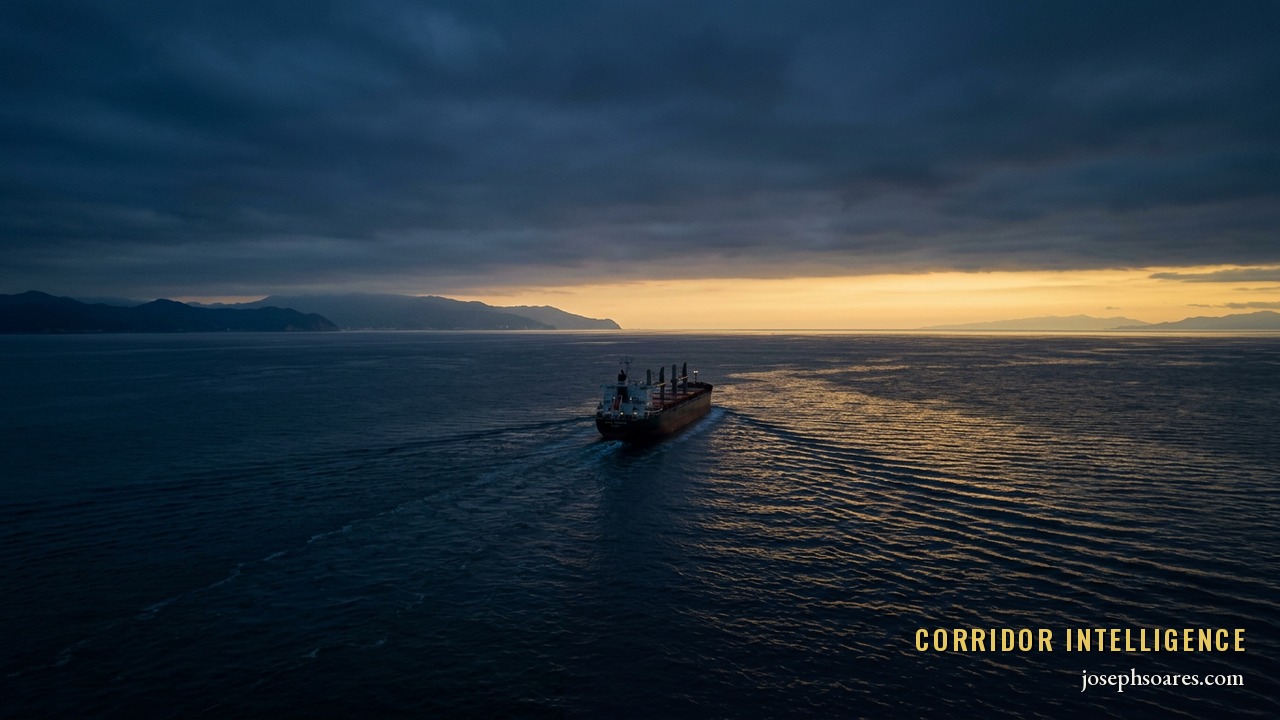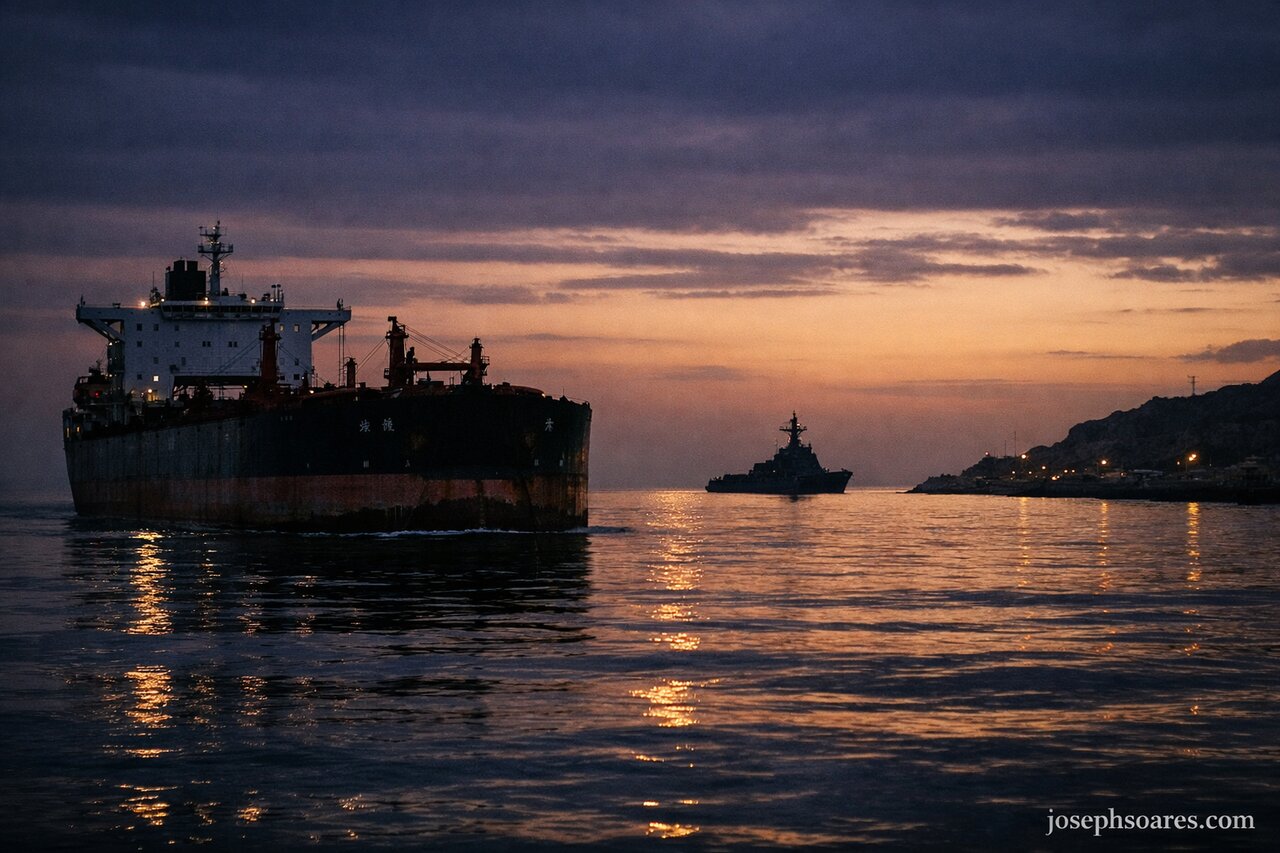
The Rich Starry transited the Strait of Hormuz on April 14 at 0800 UTC. Chinese flagged. Iranian crude in the hold. Pentagon claims it got turned back. Reuters shipping data and Automatic Identification System records say it made the crossing. Someone is lying. The world is watching to find out who.
This isn't about one ship. It's about whether the United States can still enforce a naval blockade in a critical chokepoint when a near-peer competitor decides to test it. The answer matters to every energy-dependent economy on the planet. It matters to every bond market. And it matters to whether the next nation that relies on American security guarantees will actually believe them.
The Test
The blockade has held for three days. No Iranian traffic. No smuggling runs. Complete enforcement. Then came the Rich Starry. A modest vessel. Chinese registry. Headed for Shanghai via a port nobody's talking about yet. It didn't announce itself. It didn't file a florid diplomatic protest. It just transited.
The Pentagon's official position: nothing got through. The blockade is 100% effective. No vessels have breached the cordon. The Strait is closed to Iranian commerce.
The shipping data tells a different story. Vessel tracking shows the Rich Starry completed its transit. AIS pings place it north of the strait at 1200 UTC. Satellite imagery confirms position. Oil tanker markets reacted with a 3% swing on the crude curve in the minutes after the crossing was confirmed. The market pricing clearly reflects: if Chinese vessels can run the blockade, the blockade is worth less than advertised.
Why Beijing Did This
China didn't announce this. No fanfare. No diplomatic cable. No chest-thumping in state media. One ship. Quiet execution. If it worked, Beijing learned something invaluable: the blockade has selective enforcement. If it failed, they lose one tanker and plausible deniability. It's asymmetric testing at its most elegant.
The strategic calculus is brutally simple. Beijing needs to know: Can we push through if we need to? The answer isn't about saving one cargo of Iranian crude. It's about the deterrent architecture of the entire Indo-Pacific. If China can run a US naval blockade with impunity, every ally watching from Tokyo to New Delhi to Canberra just recalculated their security equations.
This is death by a thousand cuts. Not one dramatic confrontation. A quiet test. Then another. Then another. Until the blockade is permeable enough that its utility evaporates.
The Strategic Signal
Every nation with a stake in Hormuz security just received the same message: the rules don't apply to Beijing the same way they apply to everyone else. Saudi Arabia takes note. Japan takes note. India takes note. South Korea takes note. UAE takes note. They're all asking the same question: when my moment comes, will the United States have my back? Or is American naval power selectively enforced depending on who's doing the testing?
This is corrosive to deterrence. Deterrence dies in the ambiguity. The moment an adversary figures out your red line is negotiable, the line ceases to exist. China just figured something out about the American blockade. Now everyone else will be testing those same assumptions.
The Trump Dilemma
Confronting a Chinese vessel is categorically different from intercepting an Iranian ship. This forces a choice no president wants: escalate with the second-largest economy in the world, or accept selective enforcement of your own blockade. There is no third option.
Escalation means a military incident with Beijing. That means naval confrontation. That means crisis management with a nuclear power in a shipping lane that moves 20% of global oil. The political cost is incalculable. Every day oil prices spike, every CEO pulls supply chain decisions forward, every energy market seizes up a little tighter.
Acceptance means the blockade becomes something less than what Washington advertised. It means Iran has a corridor if it moves through Beijing. It means selective enforcement becomes standard practice. And it means the next nation testing American resolve knows exactly where the line really is.
I've been in rooms where these decisions get made. This is the kind of moment that determines whether you look strong or weak for the next decade. There is no good option here. There are only costs.
What The Markets Know
The oil curve's response was immediate. The premium built into crude pricing assumes total blockade closure. Selective enforcement means that premium is overstated. If Chinese vessels can run the strait, crude supply is marginally less constrained than the market had priced. The derivatives market understood this in minutes.
Every company with exposure to oil pricing, shipping costs, energy inputs, or logistics just watched their cost assumptions become unreliable. The risk they hedged for—total closure—is now less likely. The risk they didn't anticipate—selective enforcement—is now real.
The business leaders who positioned correctly are vindicated. The ones still modeling on the assumption of total blockade are now exposed.
What Comes Next
If the Pentagon announces the Rich Starry got through, they admit the blockade is permeable. Every maritime shipper in the world sees an opportunity. Every Chinese tanker becomes a test run. The blockade unravels not with one dramatic failure, but with a thousand quiet transits.
If the Pentagon maintains the lie—that the vessel was turned back—then everyone with satellite access, shipping data, and AIS tracking knows the Pentagon is not a credible source of information. That's worse. That's credibility collapse. When your government can't maintain basic facts about your own military operations, every ally questions whether any of your commitments are real.
The third option is escalation. But that triggers regional conflict at a moment when the administration is managing economic consequences of the blockade that nobody saw coming. Escalation is politically untenable.
So the blockade transitions. It becomes selectively enforced. Chinese vessels transit. Iranian oil moves through Beijing. The energy markets reprice. The deterrent architecture shifts. And every nation watching understands that American security guarantees are negotiable depending on who's doing the asking.
Beijing called. Washington answered. And the strait has new rules now.