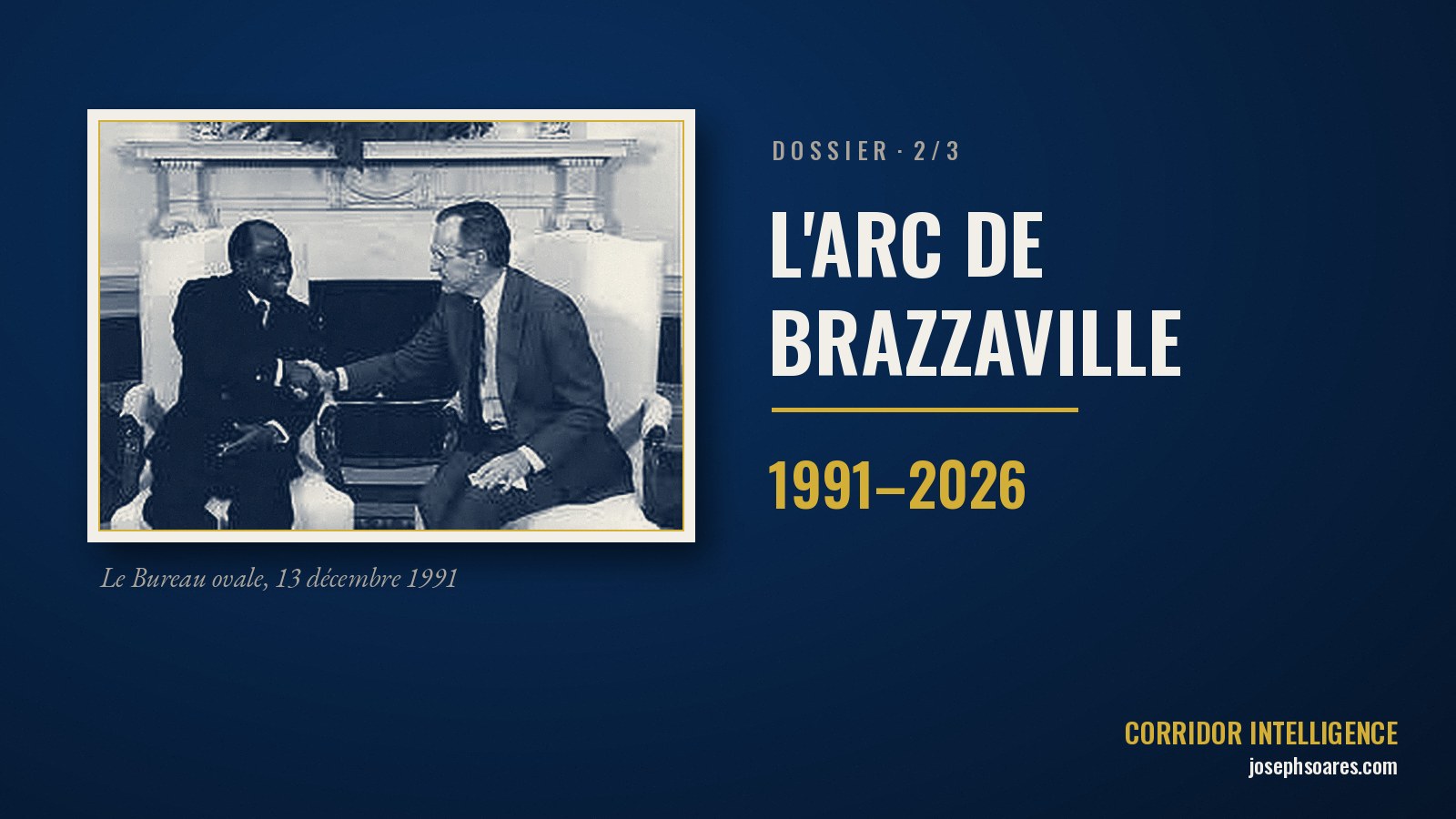
On December 13, 1991, at 11:30 a.m., the transitional prime minister of the Congo walked into the Oval Office. The conversation lasted ten minutes. The official record fills two pages. And in those two pages, André Milongo told the President of the United States three things: the state could no longer pay its civil servants' salaries; the country was asking to reschedule its debt; and the companies producing its oil would not turn over their books [Memcon 1991].
Thirty-five years later, the first part of this dossier documented the same three realities, figure by figure, in the publications of the IMF, the World Bank and the EITI. This second part reads the 1991 document line by line, against the figures of 2026. The document is a White House memorandum of conversation, held at the George H. W. Bush Presidential Library, declassified under Executive Order 13526 and processed under FOIA request 2009-0275-S [Bush Library]. Every quotation below is taken verbatim from the released document.
I. Two Pages of Archives
Around the table: President George H. W. Bush, National Security Advisor Brent Scowcroft, Secretary of State James Baker, Assistant Secretary of State for African Affairs Herman Cohen. Across from them: Prime Minister André Milongo, his foreign minister Jean-Blaise Kololo, and Congo's ambassador in Washington, Roger Issombo [Memcon 1991]. Milongo's visit to the United States, December 8–14, 1991, appears in the State Department's official register of visits by foreign leaders [State Dept.]. The State Department’s own briefing memorandum for the meeting, also declassified, confirms its agenda: support Congolese democratization and encourage economic reform [State briefing 1991].
The context fits in Milongo's own words: "The Congo now has a transitional government […] We are organizing multi-party elections -- that is our major challenge." And he adds: "If we fail, then democracy for the region fails." [Memcon 1991] The Sovereign National Conference had just entrusted the country to this senior official who had come through the World Bank, with a one-year mandate: lead the Congo to free elections.
Then the conversation turns to the economy. That is where the three sentences are.
II. The First Sentence: The Salaries
"We have problems with our salaries for our civil servants." [Memcon 1991]
December 1991. The head of the Congolese government says it to the President of the United States, in the Oval Office, as an established fact.
December 2025: the IMF's country report breaks down Congo's domestic arrears — roughly one third of the stock is social arrears: salaries, pensions and scholarships [IMF 2024]. In November 2025, three pensioners' organizations presented their own count to the Congolese Senate: 50 months of unpaid pensions accumulated since 2016 [allAfrica]. A civil servant who is not paid is a family that does not eat. The sentence of 1991 still conjugates in the present tense — only the scale has changed.
III. The Second Sentence: The Debt
"We do face a debt problem. We owe the U.S. $9 million, and we would like special treatment." [Memcon 1991]
Milongo asks to benefit from the "Toronto system" — the relief terms that official creditors then reserved for the poorest countries. He pleads that the Congo, classified as intermediate income, really is not. Bush answers with a question: any headway with the IMF? And Milongo replies: "We did have a program with them but we slipped off. We are now renegotiating the program." [Memcon 1991]
The year he speaks those words, Congo's external debt stands at US$4.79 billion against a GDP of US$2.72 billion — roughly 176% of GDP [WDI]. In 2026, public debt stands at 97.2% of GDP, the country is classified in debt distress by the joint IMF–World Bank analysis, and a program with the Fund is once again the horizon of fiscal policy [IMF 2026] [DSA 2026]. The ratio has changed. The conversation has not.
IV. The Third Sentence: The Books
"… they have -- well, habits -- and they won't turn over their books." [Memcon 1991]
It is the heaviest sentence in the document — and the declassified copy carries the mark of its weight: the first half of the line, where Milongo names the producers he is talking about, is struck through in the version released to the public. What remains legible is enough: the prime minister of the Congo is telling the President of the United States that those who produce his country's oil will not show him the accounts.
Twenty-six years later, the international extractive-industries transparency process (EITI) would put a number on that sentence: in 2017, only about 13% of the proceeds of the Congolese State's oil sales reached the treasury, the rest servicing oil-backed loans [EITI]. The man who asked to see the books in 1991 had asked the right question. It is still waiting for its full answer. In the meantime, American diplomacy had reached the same conclusion: in April 1994, an internal State Department report, since declassified, relayed a World Bank mission's finding that Congo's oil sector was “as opaque as ever,” with roughly US$540 million in royalties already mortgaged [State 1994].
V. The Table Knew
What is striking in the record is that no one around the table disputes the diagnosis. Assistant Secretary Cohen opens the subject: perhaps the Congo's economic problems could be helped by "a more equitable return on your oil production." Then James Baker, the Secretary of State of the United States, cuts through:
"Excuse my bluntness, Mr. President, but I am afraid our friend is getting ripped off. They're not paying you what you deserve." [Memcon 1991]
Bush suggests opening up the oil sector and asks how long the current contracts run. Milongo answers that he is not sure — it varies. Two American companies, Amoco and Conoco, are producing in the Congo at the time; Baker notes that Amoco, for its part, is "giving you a fair shake and making a profit" [Memcon 1991]. The problem, then, was not the oil, nor even the profit. It was the opacity — and everyone in the room could see it.
VI. The Question of the Arc
Now widen the frame. The Congo has been independent since August 15, 1960. That year, its income per person was comparable to South Korea's, a country emerging ruined from its war. Here is what the World Bank series says, in current dollars [WDI]:
| Country | GDP per capita, 1960 | GDP per capita, 2024 |
|---|---|---|
| Congo-Brazzaville | US$125 | US$2,482 |
| South Korea | US$159 | US$36,239 |
| Singapore | US$428 | US$94,897 |
Nearly the same starting point. Sixty-four years later, a South Korean produces fourteen times more than a Congolese. And the Congo holds what Korea never had: oil, timber, and one of the rare deep-water ports on Africa's west coast.
So the question of this dossier asks itself, and it accuses no one: why does the country not work? Why are the salaries of 1991 still the arrears of 2026? Why is yesterday's rescheduled debt today's debt distress? Why are the books Milongo asked to see still not fully open? These are not questions about people. They are questions about a system — about how decisions are made, accounted for, and handed over.
VII. What Comes Next
André Milongo went back to Brazzaville with promises of electoral equipment and a problem of unopened books. The elections were held. The transition proved that peaceful change was possible — and then the arc closed back onto the same figures. The third part of this dossier changes register: it takes the form of a briefing — what the government could consider, and the choices that restore room to manoeuvre. It begins exactly where 1991 stopped: show the books.
Scope of the evidence. This second part rests on a single primary document — the White House memorandum of conversation of December 13, 1991 (Scowcroft Collection, Presidential Memcons Files, OA/ID 91109-004, George H. W. Bush Presidential Library; declassified under E.O. 13526, review 2009-0652-MR, FOIA request 2009-0275-S) — supplemented by the State Department's register of visits, two State Department documents declassified under FOIA (the December 1991 briefing memorandum and an internal April 1994 report), the World Bank's World Development Indicators, and the institutional documents already cited in part one. The memorandum records a ten-minute conversation; it is quoted for what it says, without extrapolation. One line of the document is partially struck through in the declassified copy; only the legible portion is quoted. The Congo–Korea–Singapore comparison rests on a single indicator, GDP per capita in current dollars, and does not claim to summarize three national histories. This text describes documents and figures; it passes judgment on no person and no party.