Two Gates, One Week
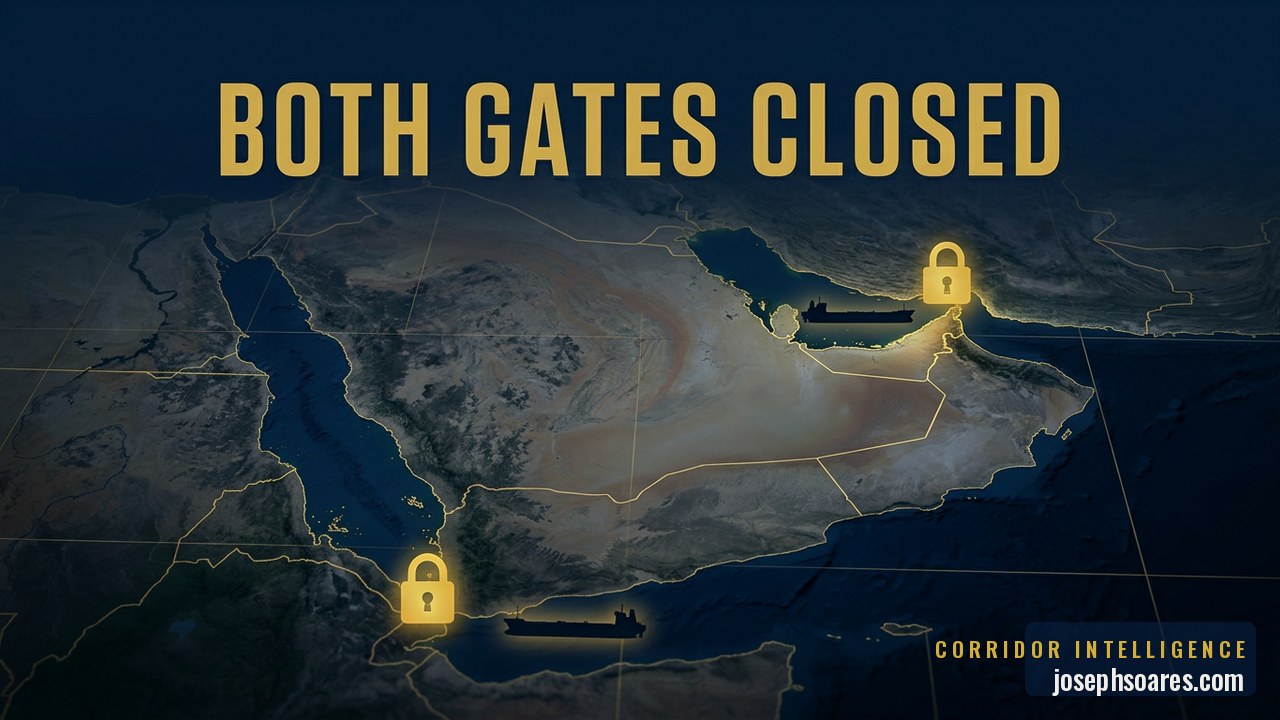
There is a number under the news this week that almost no one said out loud, so we will say it here: two. Not the seventeen American dead. Not the fifty-percent tariff. Not the ninety-six-dollar barrel. Two — as in two closed exits from the world’s oil, at once, for the first time in the modern history of seaborne energy. The Strait of Hormuz was already choked by eleven straight nights of U.S. strikes. This week the Houthis declared a naval blockade of Saudi Arabia and turned back two Saudi tankers in the Red Sea, closing Bab al-Mandeb behind it. The kingdom had spent two years rerouting more than seventy percent of its crude through the Red Sea precisely to escape Hormuz. This week both doors shut on the same hinge.
That is the week. Everything else is commentary.
What Happened, Compressed
If you read the Briefs, you already have the sequence, so we will keep it tight. Oil that started July in the low seventies is now Brent near $96 and WTI around $88, with analysts openly modeling $100 — a move of roughly a third, and the market has stopped treating it as a spike and started treating it as a regime. Gold is holding above $4,000, up nearly twenty percent on the year, which is the smart money quietly buying insurance while it stays long risk. LNG carriers have stopped transiting Hormuz entirely; Asian spot gas is up twenty-five percent in a month with heating season coming. Saudi loadings fell from 9.5 to 6.1 million barrels a day — barrels already off the water, not a threat on paper.
Into that, Washington reached back to Section 338 of the Tariff Act of 1930 — a statute that had gathered dust for the better part of a century — to impose a fifty-percent wall on roughly $20 billion of Canadian goods: wine, dairy, furniture, hockey gear. Energy, potash, and critical minerals were carved out. The Prime Minister, Mark Carney, declined to retaliate dollar-for-dollar and agreed to intensify talks inside a thirty-day window. Mediators — Qatar, Egypt, Pakistan, Oman — are now floating a ten-day cooling-off that would reopen both lanes on a “service fee” model. Washington is still bombing and has not signed.
Why the Consensus Read Is Incomplete
The consensus read is that this is a war premium, and war premiums revert. Sign the ceasefire, reopen the straits, and oil drifts back toward the seventies by autumn. That read is not wrong. It is incomplete in the one way that costs money.
Here is what it misses. The price of oil is no longer being set by barrels in the ground; it is being set by physical passage. The IEA notes global supply is still running 9.4 million barrels a day below pre-war levels — the world is pumping into a market with its safety cushion removed. When the binding constraint is a hull’s ability to transit a strait rather than a well’s ability to produce, the price stays elevated until the strait actually clears, and it moves violently on every incident because there is no spare capacity to absorb a shock. Trump’s new doctrine — one piece of Iranian infrastructure destroyed for every ship Iran hits — removes the off-ramp mechanically: each tanker now triggers an automatic escalation, so the conflict compounds with every incident rather than settling.
So even if you believe in reversion, the path there is a wide band of volatility, not a glide. A ten-day ceasefire, if it comes, is a breather to reposition — not an all-clear. Iran’s anti-ship capability has not been degraded; it has been demonstrated. The deeper thing the consensus misses is the convergence. Read the two headlines together — both straits closed abroad, a dormant 1930 statute revived against Canada at home — and the same signal is flashing from both: geography is being repriced as risk. The efficient map, the one that routed the cheapest barrel through the narrowest strait and the closest border, is being dismantled in real time. The distance between the efficient map and the resilient one is the premium, and it is now visible everywhere at once.
The Corridor Angle
First, for capital: the rotation is already underway and it is not subtle. Money is leaving the AI-hardware narrative and moving toward hard assets and proven cash. Apple retook the world’s-most-valuable crown from Nvidia. Alphabet beat on cloud growth of eighty-two percent this week and the stock still fell about five percent — because management raised the 2026 AI capex bill toward a record $205 billion and the market has finally started demanding the payback, not the promise. The phase where proximity to a story was itself a valuation multiple is closing; the phase where you must show the cash — and show it survives a live energy shock — is opening. Check your concentration risk in anything priced for perfection.
Second, for operators: stop modeling energy as a line item and start modeling it as geography. Where do your barrels, your gas, your inputs physically travel, and how many hostile gates do they pass through to reach you? Chevron is reportedly moving on two Iraqi fields and a pipeline to the Syrian coast — the smart money is building the Hormuz bypass now, buying infrastructure that outlives the war. The question for every board is which chokepoint sits inside its own supply chain, and what the bypass costs before it is needed rather than after.
Third — the corridor thesis proper — for Canada. The same week two foreign straits closed, Ottawa was reminded that treaty coverage is not a shield: CUSMA compliance did not stop a fifty-percent tariff. There is a strategic gift buried in that insult. A country whose energy, potash, and minerals were explicitly carved out of the tariff has just been told, in the plainest terms Washington knows how to speak, exactly where its leverage lives. And Carney has been acting on it: a one-million-barrel-a-day pipeline from Alberta to the Pacific for Asian markets, a $2 billion domestic order for armoured vehicles built in Ontario, a stated pledge to double non-U.S. exports within a decade. Having served in Canada's Prime Minister's Office during the 2008 financial crisis, our team reads this as the most important repositioning of Canadian trade posture in a generation — the country finally pricing U.S. market access as a political variable rather than a birthright.
[STORY NEEDED: a specific, verifiable Canadian mid-market operator that has already rerouted or nearshored away from single-buyer U.S. dependence — to ground the Canada corridor argument in a real firm.]
What To Do, What To Watch
Do three things. Rebuild your operating budget on Brent in the mid-$90s as the working floor, not the seventies you banked on — every margin and inflation forecast built on cheap energy is stale. Map the chokepoints inside your own supply chain and price the bypass now. And if you have Canadian exposure outside the exempt categories, treat U.S. access as a cost that keeps rising and diversify the buyer, not just the product.
Watch four gauges. The ceasefire signature — until it is signed, price the volatility, not the resolution. The $4 U.S. pump price — the number that turns a distant war into domestic political pain and boxes in a Fed that meets next week under pressure to cut into rising oil. Gold above $4,000 — the cleanest tell that fear is structural. And the thirty-day Canada tariff clock, where the real question is whether provincial hawks force Carney’s hand before the window closes.
The operators who get surprised next quarter will be the ones who treated this week as weather. It is not weather. It is the climate changing. Two gates closed on the same hinge, and a dormant statute woke up against a friend — and both were telling you the same thing. The map you optimized for is gone. Build for the one that is arriving.