The Corridor Is the Strategy
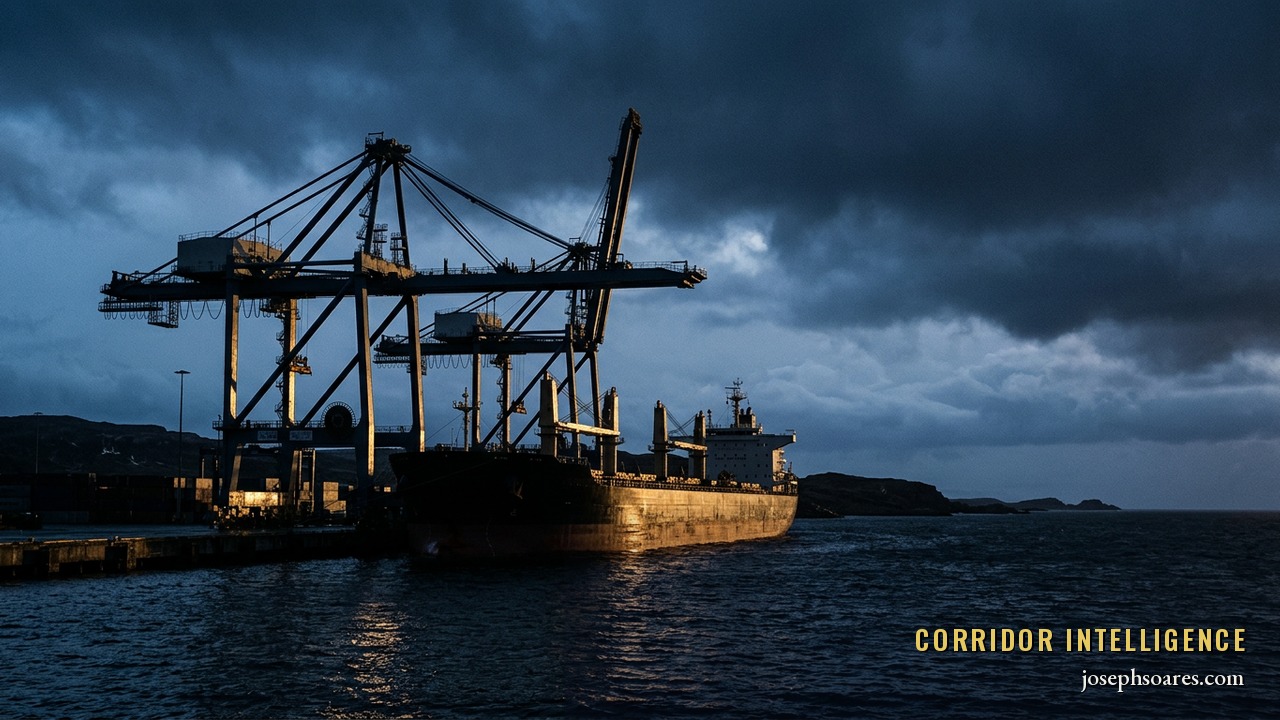
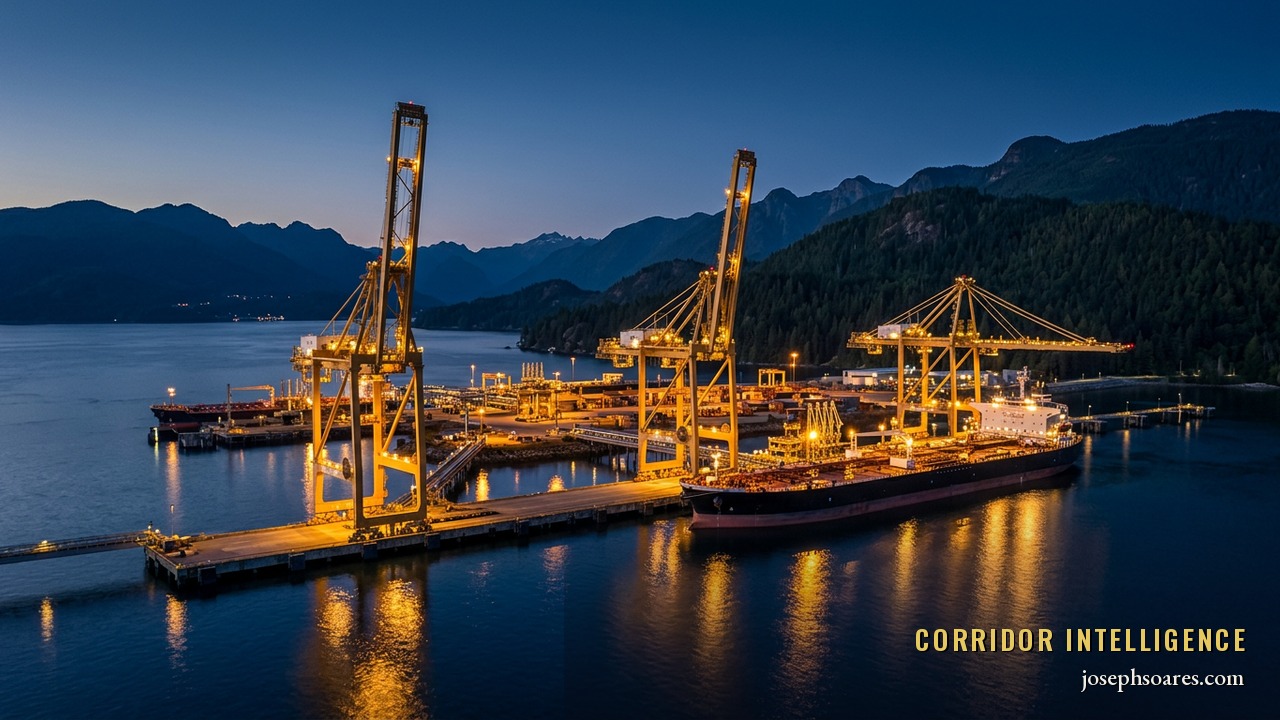
For months this desk has argued a single thesis: Canada’s deepest structural vulnerability is not tariffs, not a hostile trade file, but geography — the fact that it sells its most valuable exports to one customer, at that customer’s price. In early July, that thesis stopped being analysis and started being infrastructure. Prime Minister Mark Carney and British Columbia Premier David Eby announced a multibillion-dollar “cooperative prosperity partnership” and a major-projects agreement, paired with movement toward a new West Coast oil pipeline developed with Alberta and a Port of Vancouver expansion. Read together, these are not separate announcements. They are the components of one thing: a Pacific outlet for Canadian energy and goods.
Strip away the language of partnerships and prosperity and the mechanism is simple. Today, Canadian crude is largely landlocked. It flows south because that is where the pipe goes, and it sells at a discount — sometimes a punishing one — because a seller with one buyer has no price power. Every barrel that can only reach tidewater through the United States is a barrel priced by the United States. A west-coast artery to tidewater changes the arithmetic. It gives Canadian producers direct access to Asian demand, and it narrows the differential between what Canadian oil fetches and what world oil fetches. That differential, compounded across millions of barrels and many years, is one of the largest silent transfers of national wealth in the Canadian economy. The corridor is designed to close it.
The Tension Worth Naming
Here is the sentence that matters, and few will say it plainly. Carney has publicly stated that Canada will not “leverage” its energy or critical minerals in trade talks with the United States. At the same time, his government is building the precise infrastructure that constitutes that leverage. Both things are true, and the gap between them is the whole story.
This is not contradiction. It is craft. Leverage that must be announced is weak; leverage that simply exists is strong. A negotiator who threatens to divert energy invites retaliation and hands the other side a grievance to organize around. A negotiator who quietly builds a second route to a second market never has to make the threat — because the counterparty can read a map. Optionality is the instrument. Once Canada can credibly sell into Asia, the United States is no longer the only buyer, and a buyer who knows he is no longer the only buyer behaves differently long before a single barrel changes course. The rhetoric of restraint and the reality of construction are working the same objective from two directions. Decision-makers should not be confused by the disavowal. They should watch the concrete.
The deeper shift is one of national posture. For a generation, Canadian strategy treated proximity to the U.S. market as destiny and integration as the only prudent path. What is emerging now is the “allied hub” posture: Canada as a reliable, democratic supplier of energy and critical minerals to allied economies across the Pacific, not a captive supplier to one neighbour. That is a repricing of the entire country’s strategic position, and it does not reverse easily once the steel is in the ground.
What It Means for Your Next Move
For energy operators, the direction of travel is now set at the highest political level, with Alberta and British Columbia both inside the tent — a federal-provincial alignment that has eluded every previous west-coast attempt. That alignment is the scarce asset. Position for tidewater access, for the narrowing of the differential, and for a demand base that no longer terminates at one border. The economics of a landlocked barrel and a tidewater barrel are different businesses; portfolios still priced for the former are mispriced.
For infrastructure and capital allocators, the package — pipeline, port expansion, major-projects agreement — signals a build cycle measured in years, not quarters. That is both the opportunity and the discipline. Capital that positions early for the corridor’s supporting assets — port capacity, rail, storage, servicing, the marine layer — captures the arc rather than the announcement. But size the timeline honestly. This is a multi-year construction thesis, and the returns accrue to those who can hold through the build.
For government-relations operators, the file to own is execution risk, because that is where this either happens or stalls. Three variables govern the outcome. First, the long-standing North Coast oil-tanker ban remains a live regulatory question; how it is resolved shapes what routes are actually viable and is the single most consequential open item. Second, permitting — the major-projects agreement is meant to compress it, but the history of Canadian energy infrastructure is a history of process delay, litigation and consultation obligations that must be met, not merely managed. Third, the multi-year build itself, exposed to political cycles, commodity swings and shifting provincial coalitions. The alignment that exists today is not guaranteed to survive an election or a price collapse.
The takeaway is not subtle, and it should not be softened. Canada is building its Pacific outlet. The corridor to Asia is opening, and with it the leverage the country has never had — the leverage its Prime Minister is careful not to name. The strategic question for every reader is no longer whether this repricing happens, but whether they are positioned before it is priced in by everyone else. Move toward the corridor. Underwrite the execution risk with clear eyes. And do not mistake the language of restraint for the absence of a strategy — the strategy is being poured in concrete on the West Coast.