The Number Nobody Led With
Twenty-eight. That's how many Russian missiles hit Ukraine in a single barrage on Wednesday night, and how many Ukraine's air defenses failed to intercept — all twenty-eight got through, killing at least seventeen people. The story that ran on every wire was a different one: Iran and Oman had reached an understanding on new shipping coordinates through the Strait of Hormuz, and Washington was targeting an announcement within days. Markets rallied on the Hormuz news. Asian equities still fell hard — the Kospi dropped 4.6% on a chip-sector selloff that had nothing to do with the strait — but the dominant frame heading into the weekend is relief: the chokepoint that shut down in March looks like it is reopening.
That frame isn't wrong. It's incomplete in the way that matters most for anyone pricing risk into the autumn. The same week Washington worked toward a deal in the Gulf, President Trump turned down Volodymyr Zelensky's request for additional Patriot interceptors — not, according to Financial Times reporting, for lack of will, but for lack of stock, citing depleted US inventories and the Middle East's own demand on the same hardware. That is the decision-grade fact of the week. Not that a strait might reopen. That the country underwriting security guarantees on two fronts just told one of them, in public, that it is out of the specific hardware that would have stopped Wednesday's barrage.
What Happened, Compressed
You read the Briefs, so we'll move quickly. Iranian and Omani negotiators closed in on coordinates for a Hormuz shipping corridor, with a joint statement reportedly in final drafting and Trump saying an announcement could land this week. Markets treated it as the week's central geopolitical signal — Asian shares even built a rally around Hormuz-deal optimism before the chip-sector selloff wiped most of it out.
Away from the strait, three fronts moved in the opposite direction. In Lebanon, two Israeli army reservists were killed by an IED in a booby-trapped building near Majdal Zoun — the first Israeli combat deaths since June's truce with Hezbollah — and Israel answered with its heaviest bombardment of Lebanon since the ceasefire took hold. In the Red Sea, the Houthis hit their eighth Saudi tanker since declaring a blockade of the Bab el-Mandeb Strait on July 22, part of a campaign that has now forced 29 vessels to turn back — a second chokepoint, running in parallel to Hormuz, that nobody is close to closing a deal on. And in Ukraine, the interceptor refusal landed two days after Russia's missile barrage went entirely unintercepted, one of the worst single nights of the year for Ukrainian air defense.
Layer in the parallel story running through Washington and Ottawa: a new 50% US tariff on a broad range of Canadian goods takes effect August 19, arriving in the same stretch in which Washington has refunded roughly $100 billion in tariffs nationwide after the Supreme Court found the underlying emergency-powers levies unauthorized — with CUSMA-compliant goods, still close to 90% of Canadian exports, remaining the exemption that actually governs landed cost. In corporate boardrooms, the AI trade kept sorting winners from spenders — Palantir's 93% revenue growth, AstraZeneca and Bristol Myers Squibb circling a roughly $400 billion pharma megadeal — while the geopolitical premium sat quietly underneath all of it, waiting to reprice.
Why the Consensus Is Looking at the Wrong Chokepoint
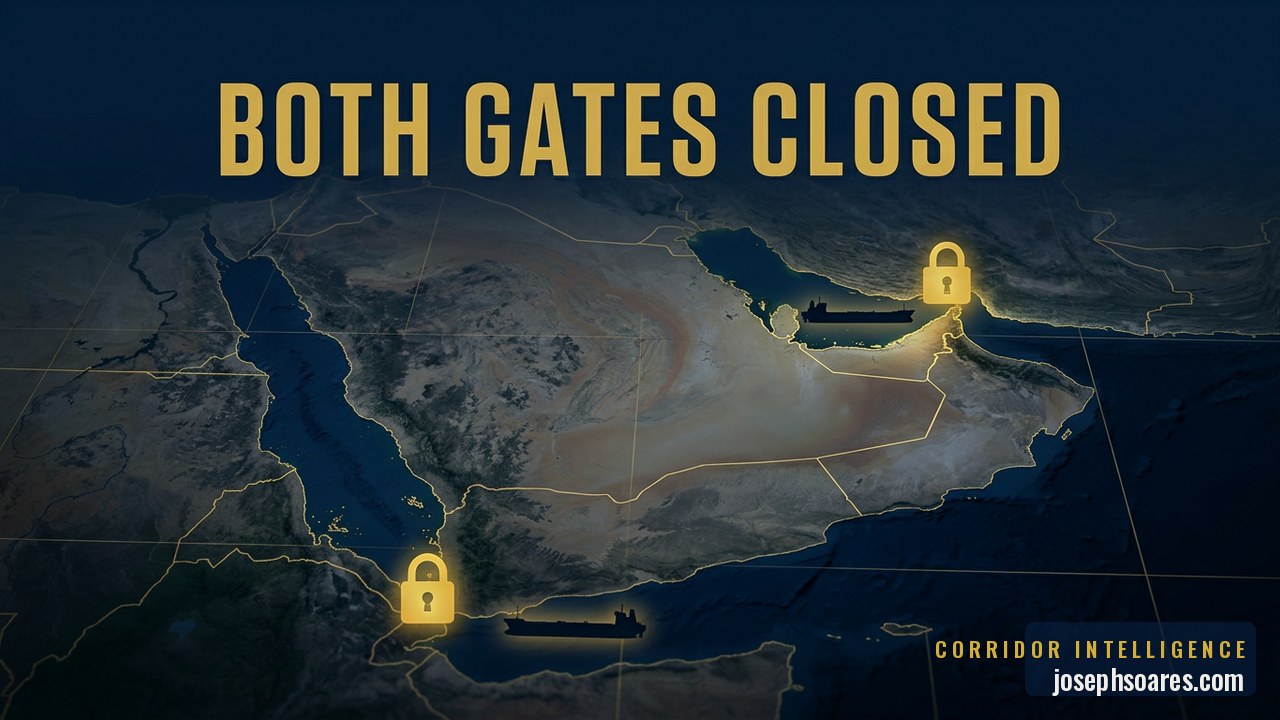
The market's read is that Hormuz is the chokepoint that matters, because it's the one with a price attached — oil, shipping insurance, freight rates. Diplomats get credit for closing it, and equities have leaned on that expectation twice this week already. But a chokepoint isn't just a strait. It's any point where a scarce, non-substitutable resource has to pass through a narrow gate — and this week Washington told the world, in the plainest language a superpower uses, that its own Patriot interceptor stockpile is exactly that kind of chokepoint now. Not unlimited. Not automatically available. Rationed, explicitly, between two theatres, with the Gulf currently winning the allocation.
That reframes everything else. A Hormuz deal, if it holds, removes one source of tail risk from energy markets. It does nothing for Lebanon, where a seven-week truce just absorbed its first Israeli combat deaths and Hezbollah's disarmament remains theoretical. It does nothing for the Red Sea, where the Houthis are escalating specifically because Saudi Arabia is routing tankers around their blockade — a second, under-covered chokepoint getting worse in the same week the first one gets the diplomatic attention. And it does nothing for Ukraine, where the interceptor shortfall is now a matter of public record rather than a battlefield inference. Three fronts, one shared and finite input. Operators who exhale when Hormuz reopens will have priced the wrong risk, because the constraint that actually governs outcomes across all three theatres — American air-defense capacity — didn't just get more available this week. It got more visibly scarce, and more explicitly rationed by a political choice about which conflict is currently the priority.
The Corridor Angle
For capital. Treat "de-escalation" headlines as theatre-specific, not systemic. A Hormuz deal lowers the energy war premium; it does not lower the security premium on Lebanon, the Red Sea, or Eastern Europe, because those risks now run on a shared, constrained input rather than independent diplomatic tracks. Portfolios and insurance books that assume one settlement de-escalates the whole region are mispriced. Price each chokepoint separately, and price the interceptor constraint as the binding one.
For operators. If your supply chain, staff, or capital touches the Gulf, the Levant, the Baltic-to-Black-Sea corridor, or Red Sea shipping lanes, the operating assumption has to change: American hardware backstops are no longer assumed to arrive on demand. That holds whether you're underwriting cargo insurance, staffing a regional office, or modelling how fast a regional flare-up could interrupt logistics. Build the plan assuming rationed, not guaranteed, external support — and revisit it every time Washington signals a new allocation choice.
For Canada — the corridor thesis proper. The tariff track running alongside all of this is its own lesson in the same discipline: headline numbers obscure the real governing variable. A new 50% tariff round lands the same stretch Washington processes roughly $100 billion in refunds on tariffs the courts struck down elsewhere — not policy incoherence, but a preview of how this administration renegotiates trade relationships tariff-by-tariff rather than through a single settlement. CUSMA-compliant status, not the headline rate, is still what sets landed cost for close to 90% of Canadian exports.
We have watched governments negotiate under exactly this kind of pressure before. I served in Canada's Prime Minister's Office during the 2008 financial crisis, and as Chief of Staff in the Senate during the 2020 pandemic. Our team reads Washington's tariff-by-tariff approach the same way we read its interceptor allocation: as a demonstrated preference for keeping leverage granular and reversible rather than locking it into one grand bargain. The operators and governments that treat every exemption, refund, and allocation decision as provisional — not as a settled floor — are the ones positioned to move when the next reallocation happens.
What To Do, What To Watch
Do three things this week. Separate your risk book by chokepoint — Hormuz, Bab el-Mandeb, Lebanon, and Ukraine each need their own probability and exposure estimate, not one regional discount. Stop assuming American air-defense or diplomatic bandwidth arrives on demand for any theatre you're exposed to, and build contingency plans that hold even if it doesn't. And keep every Canadian exemption or refund filed as conditional, revisited monthly against the compliance line, not banked as permanent.
Watch four gauges into next week. Whether Tehran confirms the Hormuz understanding through its own official channels — an Iranian denial has broken this exact narrative twice already this summer. Whether the Lebanon truce holds past Israel's retaliatory strikes or breaks into a second front. Whether the Houthis escalate further against Saudi tankers now that diplomatic attention has moved to Hormuz. And Friday's US jobs report, which will decide the Fed's September path and, with it, how much capital is available to reprice any of this.
The Hormuz deal, when it's announced, will be the headline every wire runs with. The interceptor arithmetic is what will still be governing outcomes in November. Build for the one that doesn't make the front page.