The Vulgarity Is Not the Story. The Gap Behind It Is.
Strip away the reflexive commentary about tone and a harder question survives. In coercive diplomacy, clarity is not the enemy of seriousness — it is often the proof of it. When Nikita Khrushchev banged his shoe at the United Nations, no interpreter was required; the theater was the message. When Lyndon Johnson deployed private language that would end a career today, the leaders across the table understood exactly where they stood. Crude speech, used deliberately, does real work. It signals that the speaker has moved past posture into operational intent, that the choreography of diplomacy has been set aside for something closer to a decision.
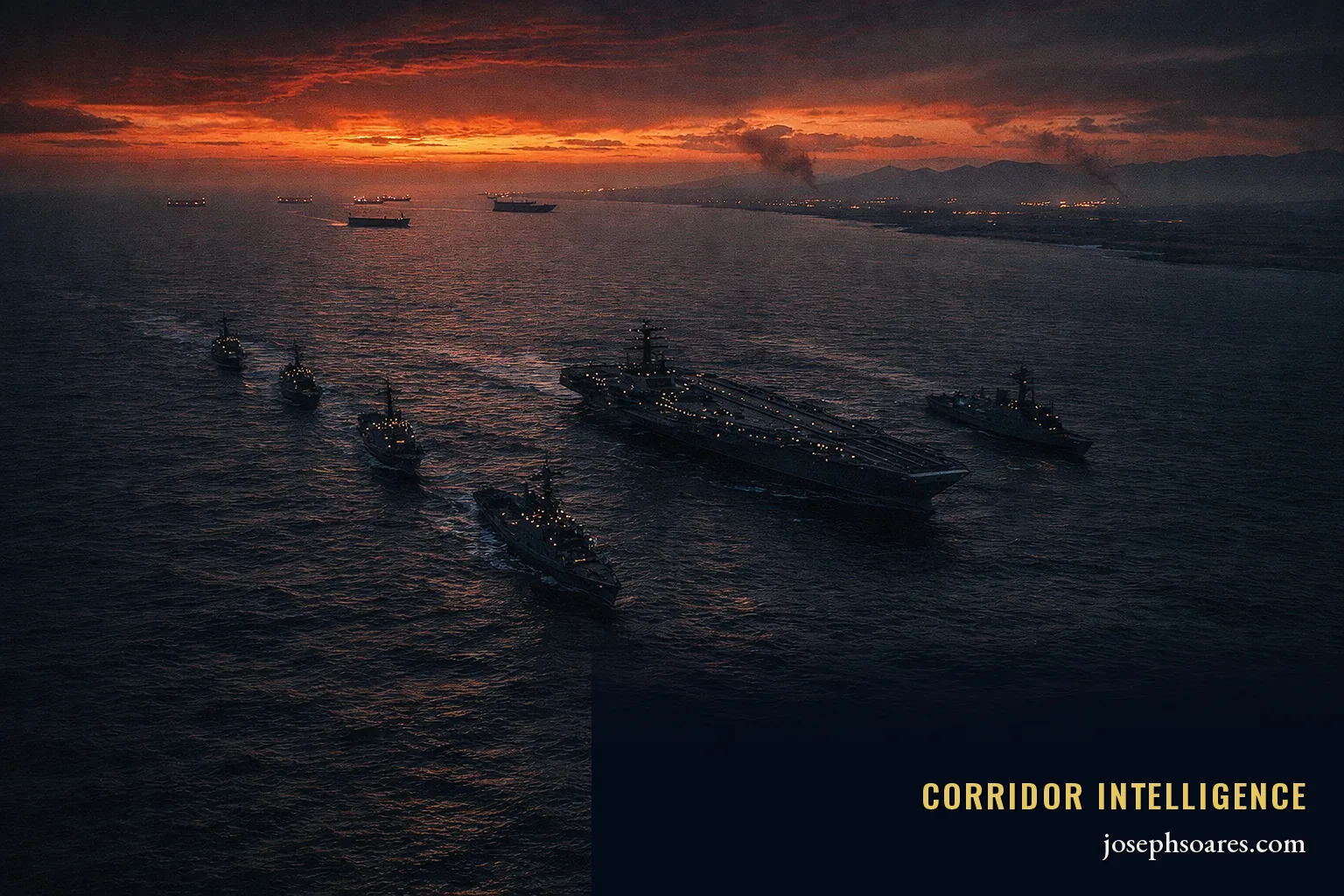
So when the President tells Tehran, in language we will leave to the headline, to open the Strait of Hormuz, the instinct to clutch pearls misreads the instrument. The profanity is not the strategy. It is a tell — a clue to whether a strategy exists at all. And that is the analysis worth paying for, because the answer moves oil futures and defense-procurement calendars far more than any adjective does.
Coercion Runs on Two Rails: A Credible Threat and a Credible Exit
Effective coercive diplomacy requires two things, and it requires both. The first is a credible threat — the adversary must believe that non-compliance carries a cost the speaker is willing to impose. The second is a credible way out — a path by which the target can comply without ceasing to exist as a functioning regime. Threat without exit is not coercion; it is a demand for surrender, and surrender is the one thing cornered governments are structurally unable to give.
On the first rail, the President’s rhetoric performs. Vulgarity reads as resolve. It compresses the distance between words and force and tells Tehran the usual off-ramps of deliberate ambiguity are gone. That is a feature, not a flaw, and analysts who dismiss it as mere temperament are missing the signal.
The problem lives on the second rail. When you publicly brand an adversary with crazed and contemptuous names, you do not merely insult a leader — you raise the domestic price of his compliance. A regime that yields after being humiliated in front of its own hardliners does not survive the concession. And regimes that cannot survive compliance do not comply. They escalate, because escalation at least preserves the fiction of strength. This is the recurring failure mode: rhetoric engineered to maximize the threat can simultaneously destroy the exit, and a threat with no exit is an accelerant, not a lever.
Controlled Escalation Versus a Lost Temper — and How to Tell Them Apart
Here is the distinction that matters, and it is not about vocabulary. Controlled escalation is vulgarity in service of a plan — calibrated, reversible, paired with a private channel that lets the other side climb down. A lost temper is vulgarity in place of a plan. From the outside, on the day of the remark, the two can look identical. They do not stay identical for long. The deadline discriminates between them.
Watch what happens when the clock runs out. If the deadline passes, the strait stays closed, and no strikes follow, the threat was theater — and every subsequent threat from this office is discounted accordingly, not only by Tehran but by Beijing, Moscow, and Caracas, who are all keeping score. Credibility is a shared account; it is drawn down globally. If instead the strikes come, the language becomes a footnote to a war, and the relevant question is no longer about manners but about whether the objective was ever achievable by force. Either outcome resolves the ambiguity. Neither is comfortable.
For those exposed to energy markets and defense supply chains, the operational read is this. Do not price the profanity. Price the gap between rhetoric and reality. Inflammatory language is signal when it is attached to a credible threat and a visible, survivable exit for the other side — that configuration tends to produce a negotiated de-escalation, and the tail risk is manageable. Inflammatory language is noise, or worse, when the exit has been rhetorically demolished — that configuration produces one of two binary outcomes, capitulation the regime cannot afford or the use of force, and it should be hedged as such. The framework does not require you to like the speaker or to trust him. It requires you to ask one question: has anyone left the adversary a door he can walk through and still call it his own? When the answer is no, the words are not strategy. They are the sound of its absence.